From agriculture to the energy industry in South Africa, water pumps are found in a wide range of applications. In particular, solar water pumps are gaining in popularity, and it makes sense since South Africa is a country rich in the resource of solar energy.
A solar water pump system is commonly used for commercial and residential applications and the irrigation of agricultural land. The system uses solar panels to eliminate the energy cost and provide a more feasible option that uses energy from the sun to pump water.

Solar-Powered Irrigation
While the world is quickly recognizing how beneficial solar energy is, using the sun’s energy for water pump systems can significantly accelerate and help the development of agriculture in Africa. This concept is known as solar-powered irrigation and is used in many African countries and remote locations.
The simple truth is that solar energy is the easiest way for farmers to produce cost-effective energy – especially for those who live off the grid for electricity and have poor infrastructure. The concept of solar irrigation represents a virtuous circle. Basically, the sun shines and generates heat energy; this energy feeds the irrigation system, which feeds the water-dependent crops. In this way, a solar water pump system allows a large quantity of energy to be released at the right time and when it is needed the most – during the day since plants also depend on the sun for growth.
Using solar-powered modern irrigation systems presents a clean, simple, and cost-effective alternative to traditional electric and fuel-driven pump systems. A solar water pump offers an environmentally friendly approach to agricultural irrigation and can exploit every region, whether it is a developed area or a rural area.
Here is an interesting fact: 40% of the global population relies on agriculture as its primary source of income. Unfortunately, access to water remains an ongoing struggle for many people. However, this is what solar aims to change. Solar energy introduces a cost-effective future for around 500 million small-scale farmers all around the world.

An Efficient Solar Water Pump System
By definition, an efficient solar water pump system receives a lot of sunlight and is explicitly installed to the farm’s needs.
In the past few years, the investment costs associated with buying a solar water pump system are coming down. However, there are several factors that influence the efficiency of a solar water pump, including:
- Economic viability
- Access to money
- Installation, operation, and maintenance
- Standardization and quality control of products and service
- Water management
- Social justice
Taking all of the above factors into consideration, one can say that a solar water pump system can provide significant environmental and socio-economic benefits at both farm and national levels:
- At Farm Level: The technology can present a reliable energy source for remote areas. This is especially beneficial for those locations that are not connected to an electricity grid or if they lack a regular supply of liquid fuels.
- On a National Level: The solar water pumping system can help diversify, increase, and stabilise agricultural production – this is the foundation of most African countries’ economies.

Buying a Solar Water Pump
There are four types of solar water pumps, namely:
- Submersible water pump
- Surface pump
- Alternate current (AC) pump
- Direct current (DC) pump
So, how do you know which solar water pump is a good buy for your needs? Below we have listed some of the factors that you should consider before purchasing a solar water pump.
- Efficiency: Solar water pump’s flow rate is a usable volume of water distributed by the pump in a particular time interval. It is denoted a letter Q and measured in the units such as; LPM, m3/h, or m3/s.
- Flow Rate: The flow rate is a critical factor that needs to be considered. It is the ratio between power supplied and power absorbed by the pump. There are three types of pump efficiencies; Manometric Efficiency, Mechanical Efficiency, and Overall Efficiency.
- Head: This represents the increase in energy accumulated by 1 liter of water between the input and the output section of the pump.
- Power: The power imparted into water increases the energy of the water per unit volume. Thus, power depends on the conversion of the mechanical energy and water elements present inside the pump.
- Speed: It is the number of revolutions executed by the pump at a particular time of interval. The speed of the water pump is denoted with the letter ‘N.’ It is measured in RPM(Revolutions Per Minute).
- NPSH(Net Positive Suction Head): NPSH indicates the solar water pump’s inability to create absolute volume. It is the first parameter that must be considered when it comes to buying a centrifugal pump. NPSH must exist during the pump’s consumption to prevent the occurrence of cavitation.
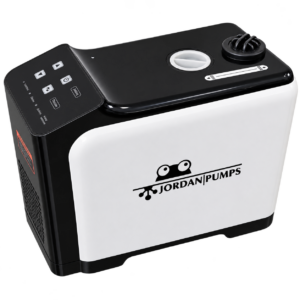
The quality of a solar water pump may vary from one manufacturer to another. Choosing the right solar water pump is vital. If you are looking for the right solar water pump system that does not compromise on quality, then look no further than Jordan Pumps. Contact Jordan Pumps today for all your agricultural pump requirements. They supply, install, and maintain water pumps for domestic, commercial, and industrial applications.