Choosing the right water pump plays a crucial role in meeting the requirements of your agricultural irrigation needs. Not only will the right water pump ensure that the water requirements for your farm are met, but it will also ensure the best efficiency so that you can get the most out of the layout of your fields.
Let’s explore how to choose an agricultural water pump that will best suit your needs.

Understanding the Basics
Before you can decide which agricultural water pump you need, you should first understand the basics of an agricultural water pump and how one works. There are several types of irrigation techniques available. However, the end goal is the same; to pump water from the main source and distribute it across the fields evenly. The main objective is to minimise your energy requirements while ensuring your fields receive an adequate amount of water.
Modern irrigation techniques can meet this objective if you use the right water pump. To ensure your field is irrigated uniformly, the entire cultivatable field is segmented into smaller areas known as zones. These zones can be differentiated based on crops cultivated, irrigation requirements, soil types, etc. Each zone is irrigated with the help of pipes, sprinklers, tubes, and valves – all of which are connected to a water pump.
Because a single sprinkler does not have the required pressure and flow to irrigate the entire area at one given time, the entire field is divided into zones to improve efficiency. The zones are easily controlled with an irrigation controller, which is either digital, mechanical, or electrical. An irrigation controller turns on and off the sprinklers in specific zones at specified times.
Your Guide to Choosing the Right Agricultural Water Pump
Step 1: Choosing the Right Irrigation Equipment
Different equipment requires different amounts of water and varying water pressure. For this reason, you must choose your equipment first before selecting your water pump. Remember, when you choose your irrigation equipment to consider the controller because it plays an important role in switching on and off the water supply at specified time intervals and during certain weather conditions.
The irrigation controller is essentially responsible for water conservation since it turns the pump off at a pre-set time so that water can adequately seep into the soil. This helps prevent infiltration and runoff.
In today’s modern times, smart pump controllers are starting to gain more popularity. These devices determine optimal water requirements for your crops and fields and use data, such as moisture, rain sensors, soil humidity, and weather.
Step 2: Think About the Water Source Type
The main rule for successful irrigation is to have adequate access to water. Decades ago, water was taken for granted and was considered an infinite resource. Unfortunately, this is no longer the case. The water situation has reversed, and there is an acute shortage of water in some areas of the country at different times of the year. This means that you should always take the right steps to ensure your water is managed efficiently on your farm.
Below are some general sources of water:
- Groundwater from wells
- Boreholes or springs
- Surface water from lakes, rivers, and reservoirs
- Non-conventional sources of water like:
- Desalinated water
- Drainage water
- Reclaimed water
- Wastewater
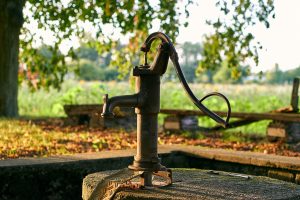
Step 3: Choosing the Right Water Irrigation Pump Type
After determining your water source for your irrigation, you need to establish the location of your water source because it will guide you as to what type of water pump you need. Here is a general idea of what water pump works best for different water sources:
- If you need to draw in water from deep undergrounds, such as boreholes, you should consider turbine pumps and deep-well submersible pumps.
- If your water source is surface water, then you can use a variety of different water pumps. One benefit of using submersible pumps with groundwater is that you can conceal the water pump to eliminate the risk of theft and to reduce the pump operation noise.
Two elements are critical to ensure a uniform flow of water, they are:
- Availability of adequate water
- The crop’s specific requirements
One recommendation when choosing the right agricultural water pump is to use more than one pump. Instead of using a single large pump, many consider using several small pumps because they offer various advantages, including:
- Decreased energy consumption
- Easy cut in/ cut off pumps based on various requirements.
- Reduced aquifer drawdown
Step 4: Finding the Right Pump Size
Choosing the right pump size is essential for the success of your irrigation system. In general, an irrigation pump for agriculture is either over-sized or under-sized.
Below are some factors to consider when deciding on the correct water pump size needed:
- Motor protection
- Power consumption
- System pressure
- Variable speed controls
Step 5: Efficiency Calculation
Before the final irrigation pump selection is made, you should calculate the overall efficiency of the system. The electricity expenditure depends on how many kW the pump’s motor runs on. The pumps and the motors in the irrigation system have varying efficiencies. Here is a simple formula to calculate the efficiency on your own:
Efficiency% = Q * H / 3.67 * P1
- Here, Q = water flow measured in m3/h
- H = head pressure measured in meters
- P1 = the kW of the motor
If mathematics and formulas aren’t your thing, then you will be pleased to know that most pump manufacturers will provide you with all the data you need, including the right efficiency. It is important to remember that your irrigation pump should do more than just transport water to the pipes and the crops.
Step 6: System Integration
Earlier, we mentioned choosing the right irrigation equipment; once you have chosen the right pump to perfectly match the irrigation equipment, you need to integrate the irrigation system as one working unit.
All your elements above need to be integrated to provide the maximum cost savings to today’s modern agriculturist or farmer. If you ensure the water pressure is not higher than required by using the proper controls, you minimise your operating costs and energy consumption.
When water is delivered at the right time and at the right precision to the crops, it results in better harvests and higher yields – this results in higher profitability. Aside from the increased revenue, the right water pump will also ensure better water management for sustainable agricultural practices.
The Bottom Line
If you need some help choosing the right agricultural water pump, then contact Jordan Pumps. They are SA’s leading providers of a comprehensive range of agricultural pumps. They will offer advice on what works best for your requirements and supply, install, and maintain the chosen irrigation water pump. They specialise in a wide range of electric and solar borehole pumps for all markets, including agricultural, domestic, and industrial. Take the hassle out of choosing the right pump alone and contact the water pump specialists – Jordan Pumps – today.