
There are several types of water pumping systems available; however, centrifugal pumps are the widest known thanks to their efficient handling of many fluids. However, before purchasing a centrifugal water pump, ensure you consider the application for which you need one because each pump has its own specifications and different types of impellers. Let’s explore pump impellers in further detail to guide you along the path of purchasing the correct pump for your needs.
What is a Water Pump Impeller?
The impeller is the rotating component found inside the design of a centrifugal pump. Its purpose is to transfer energy from the water pump’s motor to the fluid.
An impeller is made up of vanes that come off an open inlet at the centre (known as the eye), which creates a centrifugal force as they turn to move fluids from the casing to the discharge port.
There are several types of impellers, and each type offers different performance characteristics that make it either more or less suitable than others for a specific application. So, how do you know which one to choose and what the differences are between them? Continue reading to find out.
Types of Water Pump Impellers
There are five types of water pump impellers, namely:
- Open Impeller
- Semi-Open Impeller
- Closed Impeller
- Vortex Impeller
- Cutter Impeller
Open Impeller
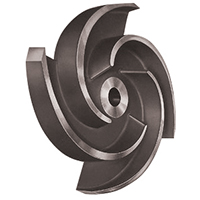
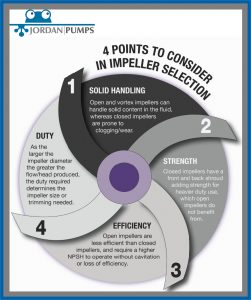
Just as the name suggests, an open impeller is made up of vanes that are open on both sides without any protective shroud. Since they lack support on either side, they are typically weaker and used in smaller, inexpensive pumps that aren’t subjected to significant strain during application. They can, however, handle a certain degree of solid content. Unlike closed impellers, open impellers require a higher NPSH (net positive suction head) to operate without incurring cavitation, damage, or loss of efficiency.
Semi-Open Impeller
Semi-open impellers have a back-wall shroud that provides mechanical strength to the vanes. The opposite side remains open. Aptly named “semi,” they are somewhat in the middle ground between open and closed impellers when comparing efficiency and NPSHr. Semi-impellers are better suited to operating within medium-sized pumps with a small amount of soft solids. However, it’s important to note that the clearance between the vanes and the pump casing needs to be small. If it is too large, then slippage and recirculation may occur.
Closed Impeller
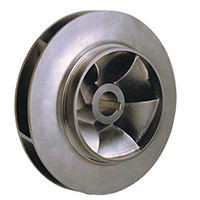
Now that you know what open and semi-open impellers are, you may know by now what a closed impeller is. A closed impeller is enclosed at the back and front and offers maximum strength. These impellers require a low NPSH and provide a more efficient flow of fluids. They are, however, more complicated and more expensive due to their reliance on close-clearance wear rings, which reduce axial loads and help maintain optimal efficiency. Closed impellers are the most popular impeller for large water pumps. They are better suited to transferring clean liquids as they are prone to clogging when they come into contact with solids.
Vortex Impeller
Vortex impellers are not channel impellers like the three impellers we discussed above. In appearance, they are similar to a semi-open type, but vortex impellers have more space in the volute and work differently, too.
Its design is ideal for handling dirty fluids containing debris, dust, and stringy solids. It creates a vacuum that keeps any solids away from the impeller as the liquid is pulled through, which prevents damage to the internal components. Its minimal risk of clogging and solid handling capabilities are beneficial, but the downside is that the efficiency is lower. For this reason, vortex impellers should only be chosen when they have to be.
Cutter Impeller
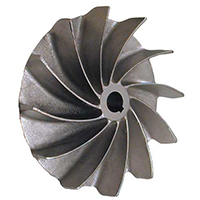
Like vortex impellers, cutter impellers are also designed to handle solids, but they enable the passing of solids differently. Cutter impellers have sharp-edged, scissor-like vanes designed to grind and obliterate any solids before they enter the water pump. They also share a low efficiency; however, they are the better choice of impeller for the pumping of sewage and other waste.
Consider an Impeller’s Diameter
Just as the type of impeller is vital to a water pump’s application, so is the diameter of the impeller when considering a centrifugal pump. The diameter can affect an impeller’s performance, and in turn, the overall performance of the pump system.
The larger the impeller, the higher the circumferential speed at the impeller output and, therefore, the greater the head and flow produced by the pump, and vice versa.
Impellers can be trimmed to meet the specific application for which you require the pump. Impeller trimming is much cheaper than using a variable frequency drive to achieve the duty point you require. However, the more an impeller is trimmed, the larger the clearance between it and the casing, which, as mentioned earlier, results in a loss of efficiency. This is why there is a limit to which a pump’s impeller should be trimmed.
Contact Jordan Pumps if you want to purchase, install, or maintain a water pump that perfectly suits your needs and has the right impeller for your application. Established in 2002, Jordan Pumps offers a full range of agricultural, domestic, and commercial pumps, including borehole, submersible, centrifugal, pressure, swimming pool, solar, solar geyser, and petrol pumps.


